




Πίνακας περιεχομένων
At a glance
- Main ingredients: nicotine (usually as a nicotine salt), a plant-based filler such as cellulose, pH regulators, flavourings and sweeteners.[1][2]
- No tobacco leaf: the pouch contains a white powder instead of ground tobacco.[1]
- pH matters: an alkaline pH turns more of the nicotine into a form that passes the mucous membrane in the mouth more easily.[1]
- Snus is different: Swedish snus is made from ground tobacco, water, salt, sodium carbonate, moisture agents and flavourings.[2][3]
The can says "tobacco-free", and the pouch looks white and clean. So what is actually inside? The answer is a short list of ingredients, most of which also appear in food. Each one has a clear job: carry the nicotine, control the pH, keep the pouch moist or give it taste. This guide goes through the list one ingredient group at a time.
What is in a nicotine pouch?
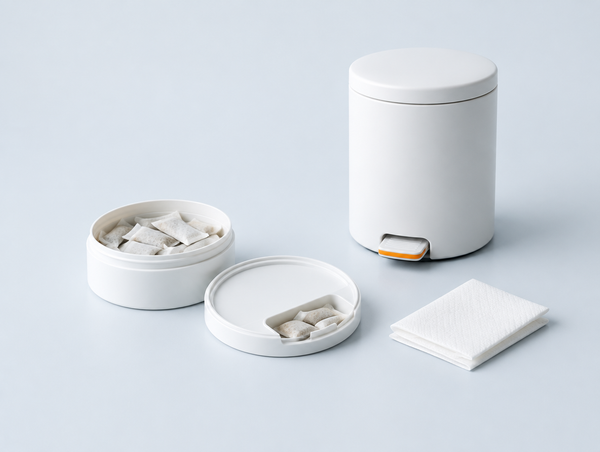
A nicotine pouch contains nicotine, a filler, pH regulators, flavourings and sweeteners, packed in a small permeable pouch. According to the German Federal Institute for Risk Assessment (BfR), the products do not contain tobacco.[1]
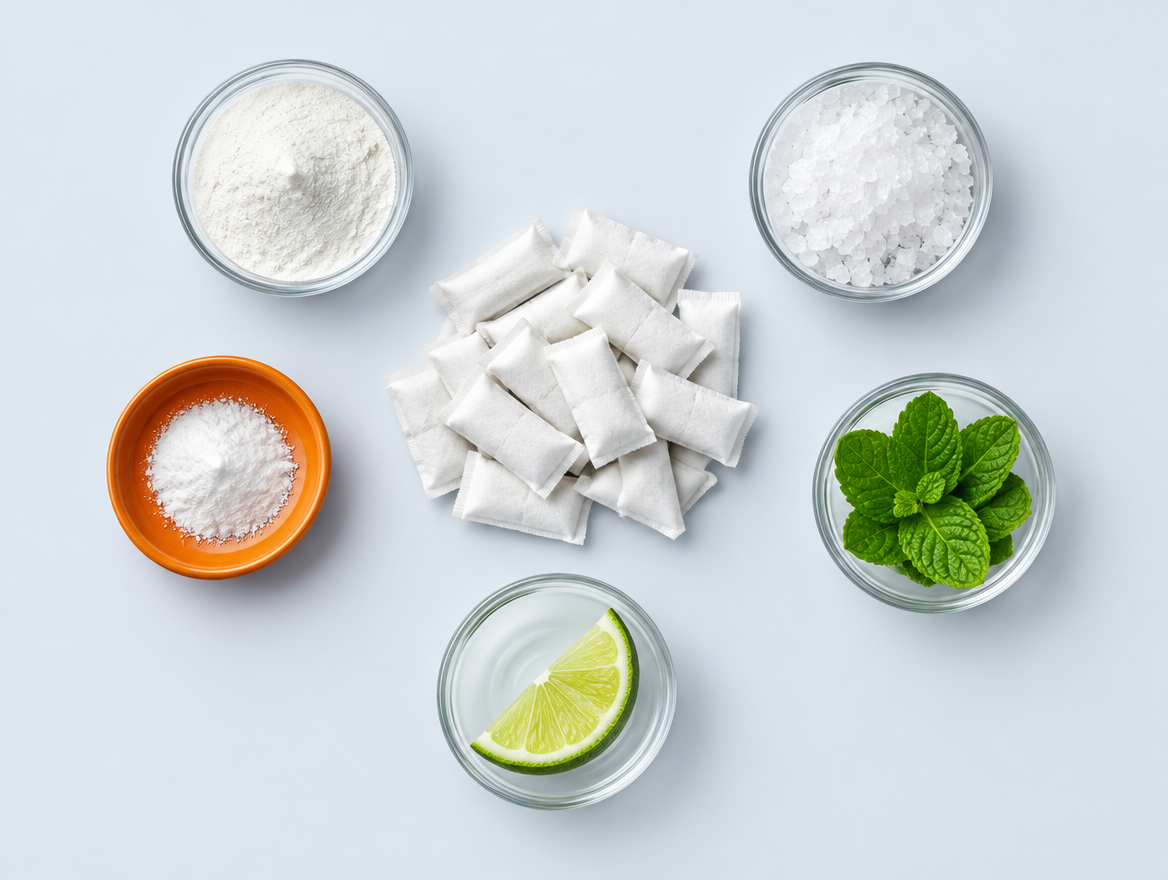
The BfR describes the content as a powder made of nicotine salts and filling materials. Based on manufacturer information, it lists microcrystalline cellulose, several salts including sodium carbonate and sodium hydrogen carbonate, citric acid and flavourings.[1] Swedish Match gives a similar list for its ZYN pouches: nicotine, fillers, pH adjusters, a stabiliser, sweetener and flavours. The company adds that all ingredients apart from nicotine are widely used in food products.[2] The WHO also describes nicotine pouches as products that typically contain nicotine, flavourings, sweeteners and other additives.[8]
The exact recipe differs from brand to brand. The table below shows the ingredient groups that appear in the sources for this guide and what each group does.
| Ingredient group | Examples | Function |
|---|---|---|
| Nicotine | Nicotine salts, for example nicotine bitartrate[1][4] | The active substance of the product |
| Filler | Microcrystalline cellulose, powdered cellulose, other plant fibres[1][4] | Gives the powder volume and structure |
| pH regulators | Sodium carbonate, sodium bicarbonate, potassium carbonate[1][4] | Raise the pH of the content |
| Humectants | Glycerol, propylene glycol[4] | Attract and hold moisture |
| Sweeteners | Sugar alcohols such as xylitol or maltitol, acesulfame potassium[4] | Give sweetness |
| Flavourings | Mint, fruit and other flavours[1][4] | Give each product its taste |
| Salts and acids | Sodium chloride, citric acid[1][4] | Support taste |
| Water | Water[4] | Moistens the powder |
If you want a general introduction before going into the ingredients, our guide what are nicotine pouches? covers the basics.
Nicotine and nicotine salts
Nicotine is the only active substance in a nicotine pouch. In most products it is added as a nicotine salt, a stable form of nicotine bound to an acid.[1][4]
The BfR states that manufacturers use nicotine salts.[1] A patent for a nicotine pouch composition names nicotine bitartrate as one example. The same patent also describes free-base nicotine bound to an ion exchange resin as an alternative.[4] The nicotine itself does not come with tobacco leaf, but the BfR notes that it may have been extracted from tobacco leaves. For this reason, trace amounts of tobacco-specific nitrosamines are possible. The BfR found such substances in more than half of the pouches it analysed.[1]
The nicotine content varies a lot. In the BfR analysis, the median was 9.48 mg per pouch. The lowest value was 1.79 mg and the highest value was 47.5 mg per pouch.[1] The BfR also found that only about a third of the products stated the nicotine content clearly in mg per pouch or per gram. Most products used a strength scale or words such as "strong" or "extra strong".[1] For this reason, the declared mg value is a more useful guide than strength words.
Plant fibre and cellulose as filler
The filler makes up most of the volume of the pouch. It is usually microcrystalline cellulose or another plant fibre.[1][4]
In a nicotine pouch, the filler carries the nicotine and the other ingredients and gives the powder a soft and even structure. The patent cited above describes the filler as a water-insoluble plant fibre and lists powdered cellulose among the options.[4] The BfR measured a median pouch weight of 0.6 g.[1] Most of this weight is filler and water, not nicotine.
The pouch material around the powder is a separate component. According to the same patent, it can be a heat-sealable nonwoven cellulose material or a material made from viscose fibres. It lets saliva pass through but keeps the undissolved powder inside.[4]
pH regulators such as sodium carbonate
pH regulators make the content of the pouch alkaline. At a higher pH, a larger part of the nicotine is in its uncharged "free-base" form, which passes through the oral mucosa more easily.[1]
Typical pH regulators are sodium carbonate and sodium bicarbonate. The patent also lists potassium carbonate, potassium bicarbonate and magnesium carbonate.[4] The BfR measured a median pH of 8.8 in the pouches it analysed. From these values, it calculated a median share of free-base nicotine of 86 percent.[1] The pH therefore has a direct effect on how much nicotine the body can take up from a pouch, not only the nicotine content printed on the can.
Two pouches with the same mg value can deliver different amounts of nicotine. The pH of the content is one of the reasons for this.[1]
Humectants, sweeteners, flavourings and salt
These ingredients control moisture and taste. Humectants keep the pouch moist, while sweeteners, flavourings and salt create the flavour profile.[4]
Humectants. A humectant is a moistening agent that attracts and holds water. The patent names glycerol and propylene glycol among the possible humectants and explains that a humectant can attract and retain saliva in the mouth during use.[4]
Sweeteners. Sugar alcohols such as xylitol, maltitol or erythritol are common, as are high-intensity sweeteners such as acesulfame potassium. According to the patent, some sweeteners also work as humectants.[4]
Flavourings. The BfR states that flavourings have a strong effect on how appealing nicotine pouches are.[1] The WHO has criticised flavours such as bubble gum and packaging that looks like sweets, because these designs can appeal to young people and increase the risk for small children.[8]
Salt. Sodium chloride appears in the patent as a flavour enhancer, together with citric acid.[4]
What does "tobacco-free" mean?
"Tobacco-free" means that the pouch contains no leaves or other parts of the tobacco plant. It does not mean that the pouch is free of nicotine.[1][5]
EU law defines tobacco as leaves and other natural processed or unprocessed parts of tobacco plants. It defines tobacco for oral use as a product made wholly or partly of tobacco, for example in sachet portions.[5] A nicotine pouch with a white powder of cellulose, salts and nicotine is not made of tobacco in this sense. EU law requires member states to ban the sale of tobacco for oral use, with an exception for Sweden.[6] By its wording, this ban covers products made of tobacco, not pouches without tobacco.[5][6]
"Tobacco-free" also does not mean "free of tobacco substances". As explained above, the nicotine can be extracted from tobacco, and the BfR found traces of tobacco-specific nitrosamines in many products.[1] If you are looking for a product without nicotine, our article on nicotine-free snus explains the alternatives.
How do the ingredients differ from tobacco snus?
Swedish snus is based on ground tobacco. Water, salt, sodium carbonate, moisture agents and flavourings are added to it.[2][3]
Swedish Match lists the following ingredients for its snus: cooking salt, which gives taste and has a preserving effect, and sodium carbonate, a basic pH-regulating agent that turns into bicarbonate in the snus. It also lists food-approved moisture agents such as glycerol and propylene glycol, and flavourings that give each brand its character.[2] A chemical study of snus describes the same development: early snus consisted of air-cured tobacco, salt and water, and humectants, alkaline agents and flavourings were added later.[7]
| Nicotine pouch | Tobacco snus | |
|---|---|---|
| Nicotine source | Added nicotine, usually as a salt[1] | Nicotine contained in the ground tobacco[3] |
| Base material | Cellulose or other plant fibre[1] | Ground tobacco[3] |
| pH regulator | Sodium carbonate, sodium bicarbonate and others[1] | Sodium carbonate[2] |
| Moisture agents | Glycerol, propylene glycol and others[4] | Glycerol, propylene glycol[2] |
| Sweeteners | Common[4] | Not listed in the Swedish Match ingredient list |
The main difference is therefore the base material. In snus, the tobacco itself is both the carrier and the source of the nicotine. In a nicotine pouch, a neutral plant fibre carries nicotine that has been added to it. You can read more about the tobacco product in our guide what is snus? and compare both product groups in snus vs nicotine pouches.
Sources
- German Federal Institute for Risk Assessment (BfR): Health risk assessment of nicotine pouches. Updated BfR Opinion No. 023/2022, 7 October 2022. www.bfr.bund.de
- Swedish Match: Frequently asked questions (ingredients of Swedish snus and ZYN). www.swedishmatch.com
- Swedish Match: Snus production. swedishmatch.com
- Patent US 11,805,802 B2: Nicotine pouch composition, granted 7 November 2023. patents.google.com
- Directive 2014/40/EU (Tobacco Products Directive), Article 2, definitions. www.legislation.gov.uk
- Directive 2014/40/EU (Tobacco Products Directive), Article 17, tobacco for oral use. www.legislation.gov.uk
- Lawler TS et al.: Chemical analysis of snus products from the United States and northern Europe. PLoS One 2020;15(1):e0227837. pmc.ncbi.nlm.nih.gov
- World Health Organization: WHO warns nicotine pouch brands targeting youth as sales surge, news release of 15 May 2026. www.who.int
This article is general information. It is not medical or legal advice for an individual case.
Βρείτε το κατάλληλο φακελάκι
Συγκρίνετε δυνάμεις, γεύσεις και μάρκες στο κατάστημά μας.
Μόνο για ενήλικες άνω των 18. Η νικοτίνη προκαλεί εθισμό. Πουλάμε τα προϊόντα που αναφέρονται στους οδηγούς μας. Το περιεχόμενό μας γράφεται ανεξάρτητα.